Mechanistic Compartmental Models
The active compartments are chosen by the disease_model.parameters.compartments
list in the input JSON file. The list order becomes the internal compartment
index order.
Vocabulary
Term |
Meaning |
|---|---|
Compartmental model |
A mechanistic model that represents the population as counts in disease states and moves people between those states. |
\(R_0\) |
Average secondary infections caused by one infectious person in a fully susceptible population under the configured contact structure. |
Rate |
Per-day transition intensity, usually the reciprocal of a mean waiting time in days. |
Infectiousness |
Ability of an infected person or compartment to transmit infection. |
Susceptibility |
Relative probability that a susceptible person becomes infected after infectious contact. |
|
Susceptible to infection. |
|
Exposed but not yet infectious. Initial exposures are placed here. |
|
Infectious and actively transmitting the disease. |
|
Infectious asymptomatic. |
|
Infectious pre-symptomatic. |
|
Infectious symptomatic. |
|
Asymptomatic infectious in SEAITRD. |
|
Hospitalized and not infectious. We consider inpatient hospitalizations sufficiently isolated to stop spreading to the general public. |
|
Treated with an antiviral, still infectious but less than an untreated person. |
|
Recovered or otherwise removed from active infection. |
|
Deceased. |
Available Structures
The model identity chooses between stochastic or deterministic versions of a model,
while compartments chooses whether optional states such as T are active.
Even with added T the identity remains the same to match the Python script of source code.
Parameter values in the templates are runnable influenza examples, not universal
estimates for every pathogen, season, or population. Scenario authors should
record the epidemiological source and calibration rationale for substituted
values. Tags notes section of template is a great place for this.
Model |
Compartments |
Notes |
|---|---|---|
SEIR |
|
Use a SEIRS implementation without |
SEIRS |
|
Adds waning immunity through |
SEITRS |
|
Adds treated infectious |
SEAITRD |
|
Gillespie and deterministic model family with required treated |
SEIHRD |
|
Separates infectious into asymptomatic, pre-symptomatic, symptomatic; hospitalization, recovered and death not infectious. |
SEITHRD |
|
SEIHRD plus treated |
All epidemics are initialized by moving the requested susceptible people into
E. A very short latent period can approximate immediate infectiousness, but
the initial state remains exposed. E is therefore a required compartment for all models.
SEIR And SEIRS Parameters
The SEIR-family models build up in the following order of complexity:
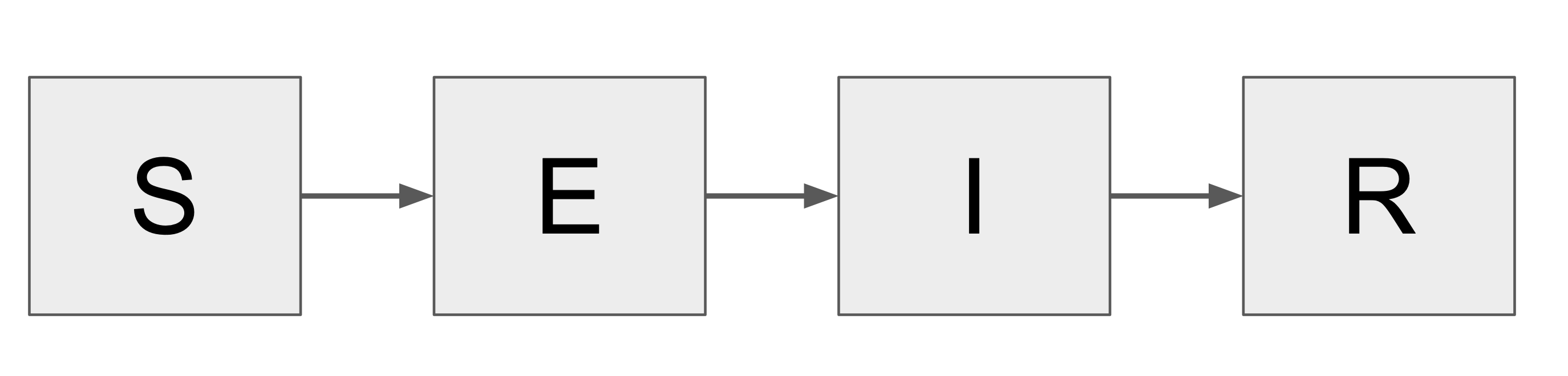
SEIR compartment structure.
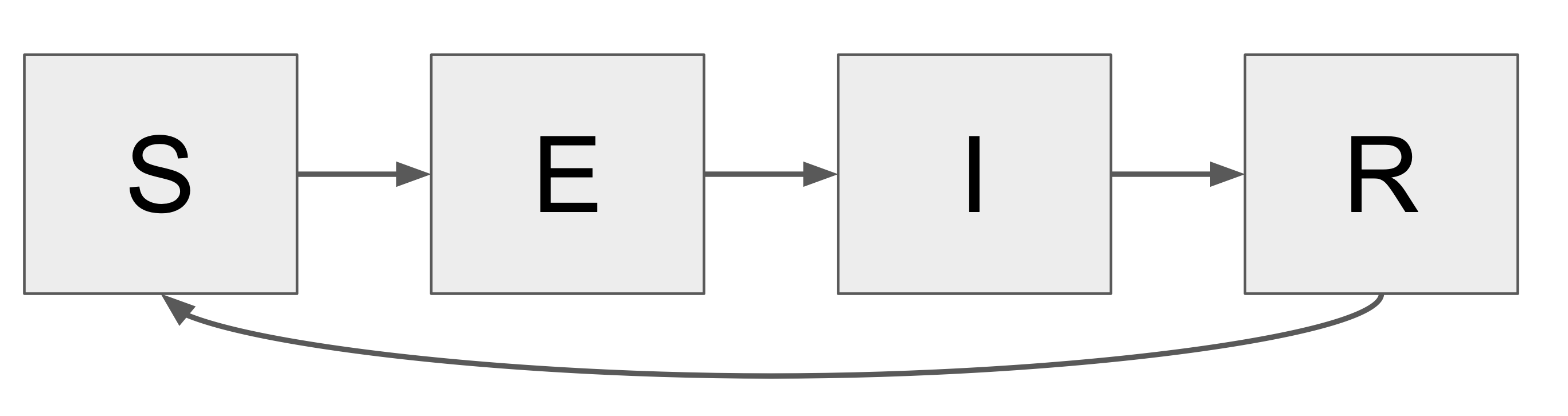
SEIRS compartment structure with waning immunity.
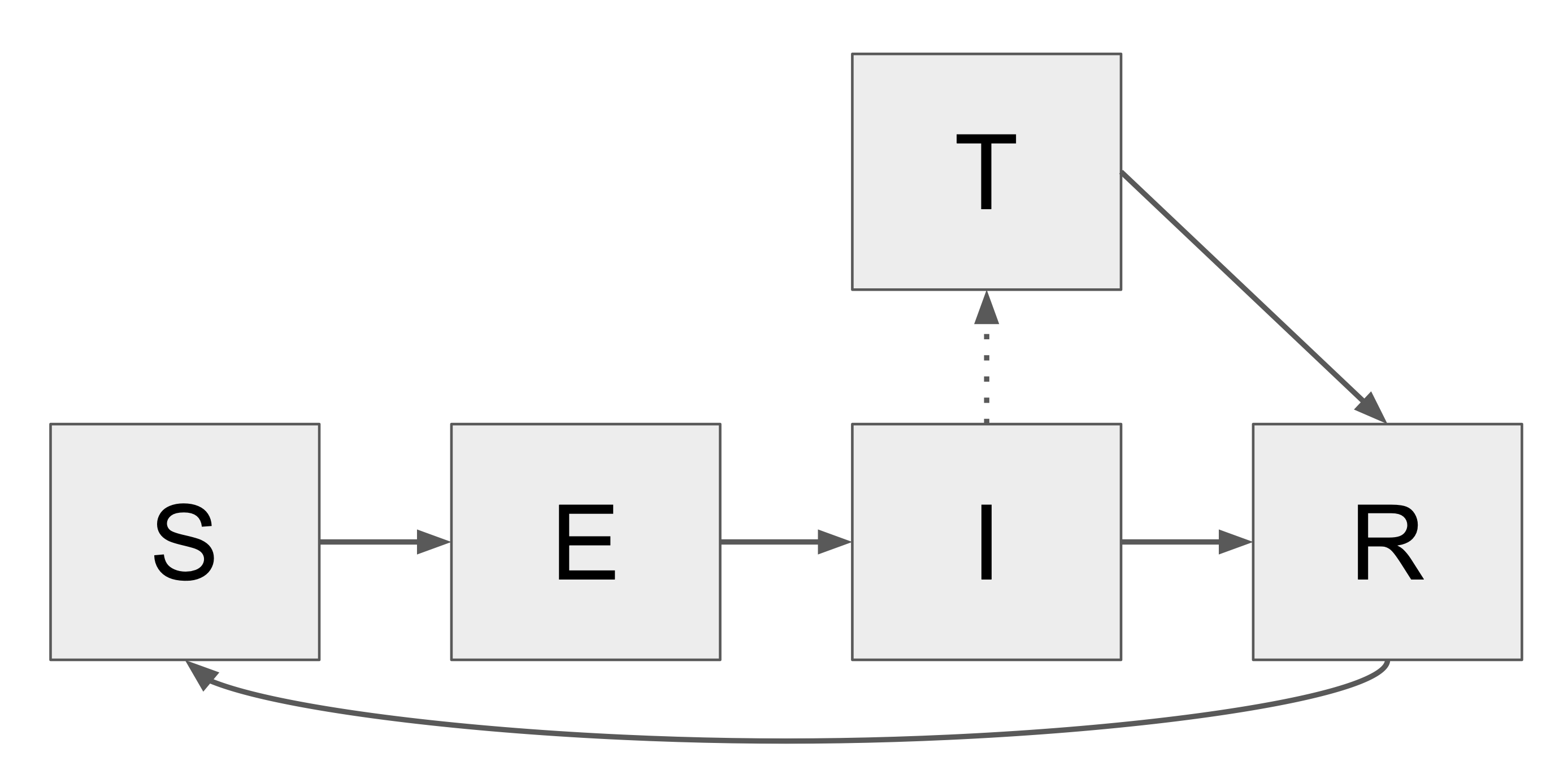
SEITRS compartment structure with antiviral treatment.
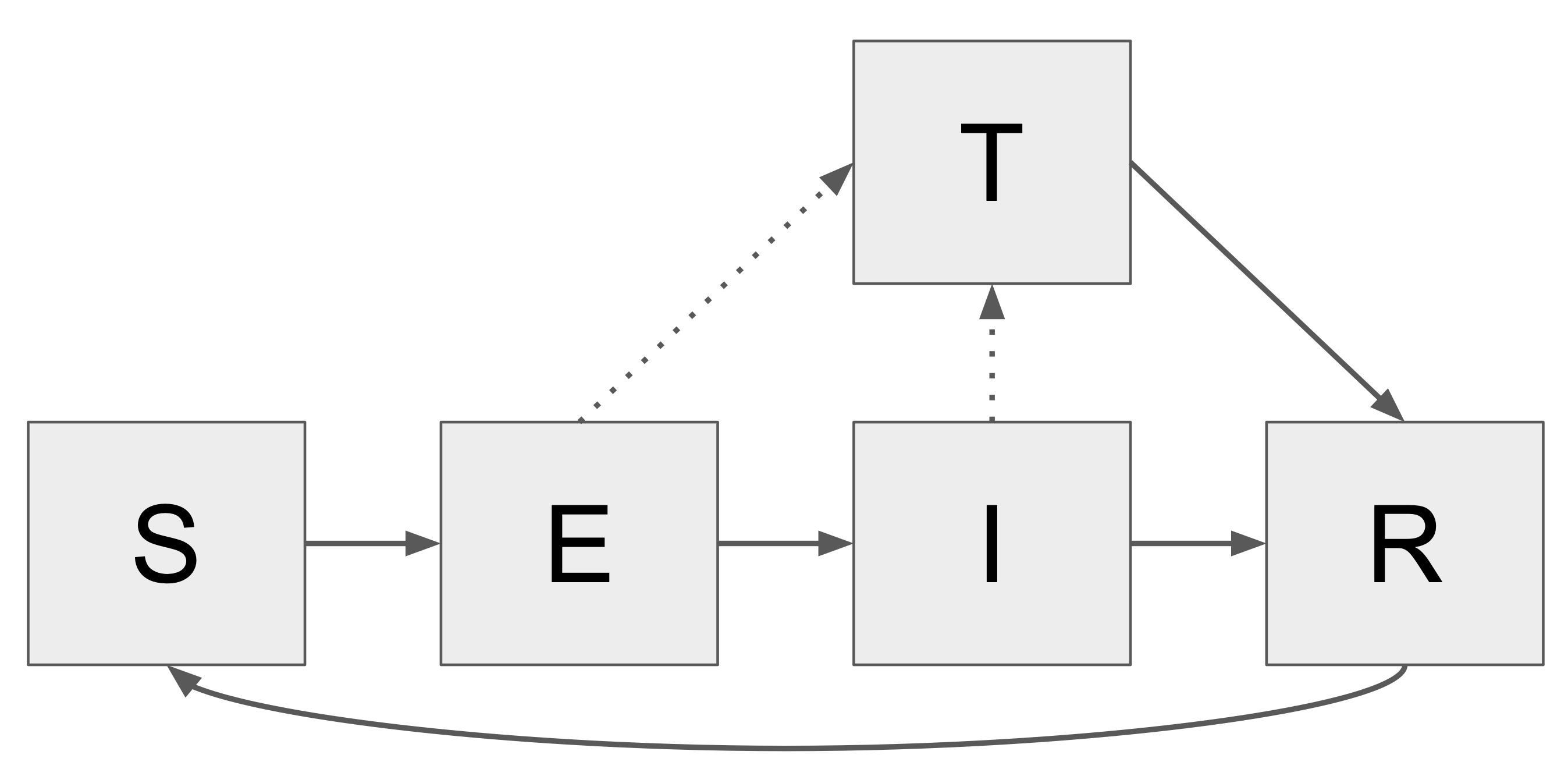
SEITRS structure with exposed people eligible for antiviral allocation.
In figures with T, dotted arrows into T indicate antiviral allocation
events. They are not disease-progression rates; they depend on available
doses and the configured priority order in the antiviral stockpile model.
Parameter |
Required |
Description |
|---|---|---|
|
Yes |
|
|
Yes |
Target basic reproduction number used to derive baseline beta. |
|
Yes |
Mean duration from |
|
Yes |
Mean duration from |
|
No |
Mean duration from |
|
No |
One multiplier per age group; defaults to all 1.0. |
|
SEITRS only |
Mean treated duration before recovery. |
|
SEITRS only |
Infectiousness of |
SEITRS Interpretation
In every antiviral-capable model, T means Treated. Anyone counted in T is
assumed to be receiving an antiviral.
In SEITRS, treated people remain infectious, but less so:
infectious pressure = I + rel_inf_T_to_I * T
People do not enter T automatically. The antiviral model moves eligible
people from E or I into T subject to available doses and prioritization.
This is deliberate: treatment is an intervention constrained by stockpile
availability, not a spontaneous clinical transition.
The same rule applies to SEITHRD. For routine treatment, eligible people
should usually move from IS into T when antiviral doses are allocated.
Set IS_to_R_days to the untreated symptomatic recovery duration and
T_to_R_days to the treated duration; for example, 7 and 5 represent a
2-day antiviral reduction. Including E, IA, or IP in
compartment_priority changes the scenario toward prophylaxis or early
treatment, so treated infectious time is no longer directly comparable to
strict IS treatment. The disease model then moves T -> H or T -> R.
antiviral_effectiveness_hosp reduces the treated hospitalization risk; for
example, 0.25 represents a 25% risk reduction, or 75% relative risk, and
does not eliminate hospitalization.
In SEAITRD, people enter treatment only through stockpile allocation. The
stockpile model moves eligible I people into T; their old queued path is
invalidated and a new T -> R/D path is drawn.
SEIHRD And SEITHRD Parameters
SEIHRD represents infections that can transmit before symptoms and can result in hospitalization and death:
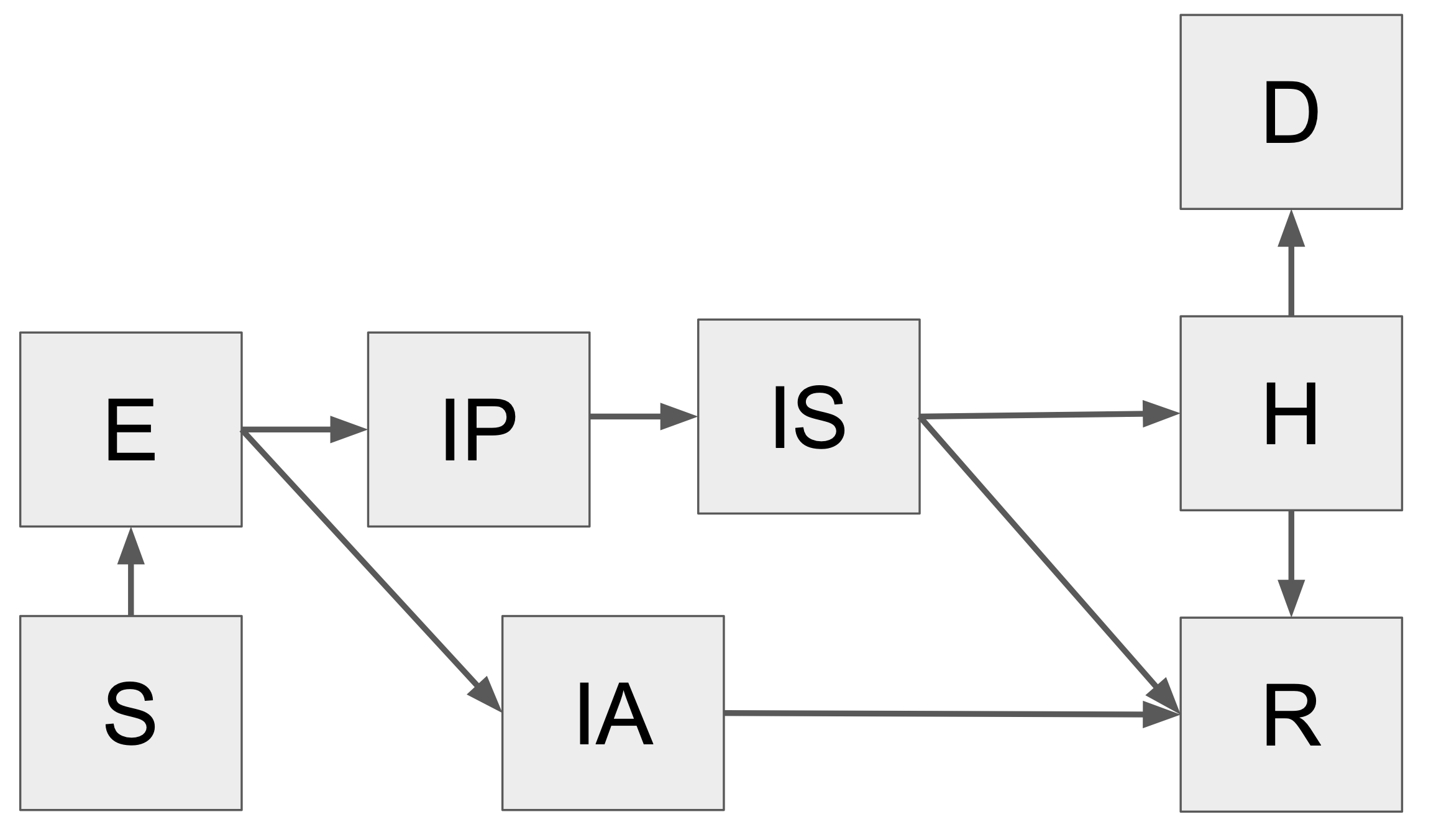
SEIHRD compartment structure.
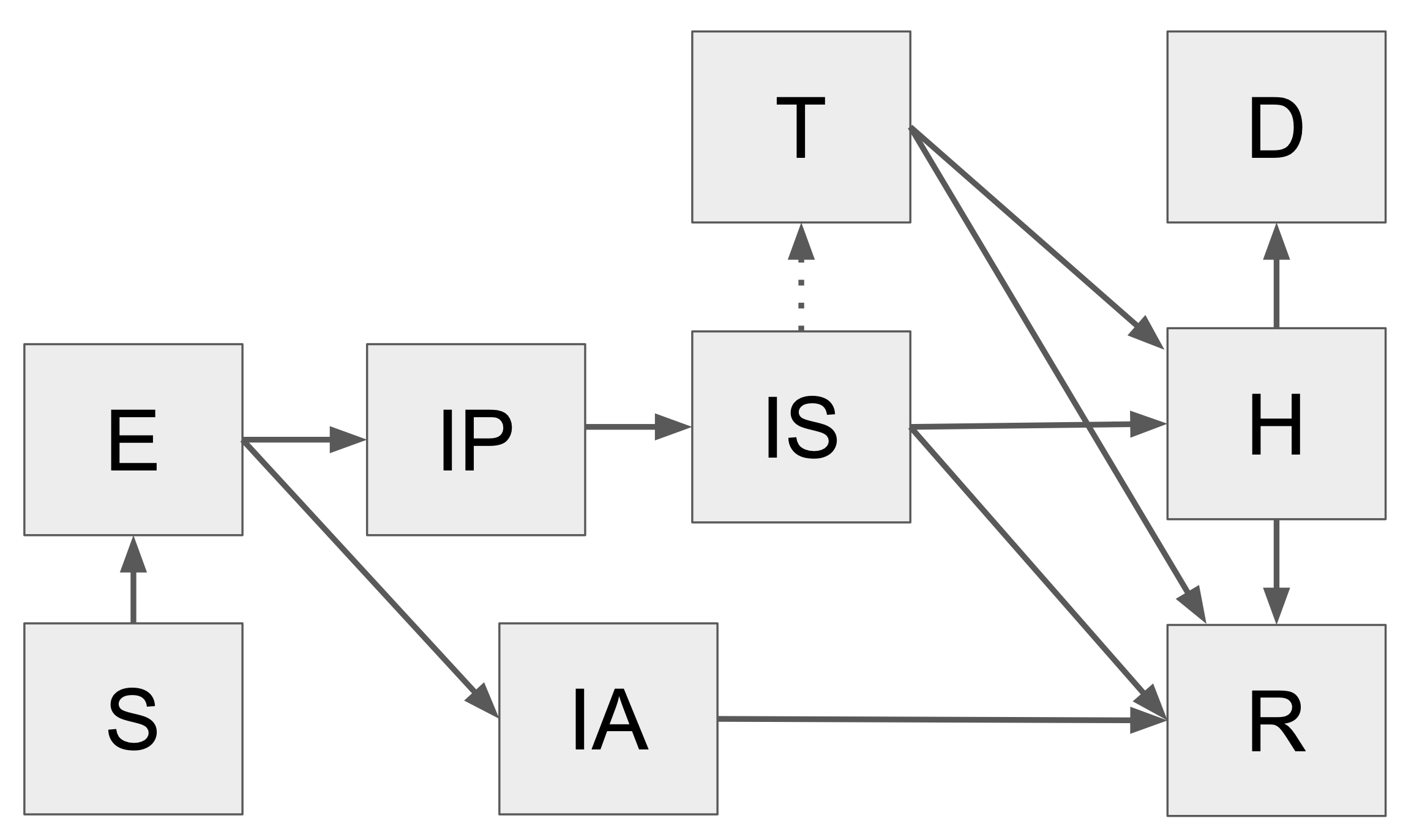
SEITHRD compartment structure with antiviral treatment.
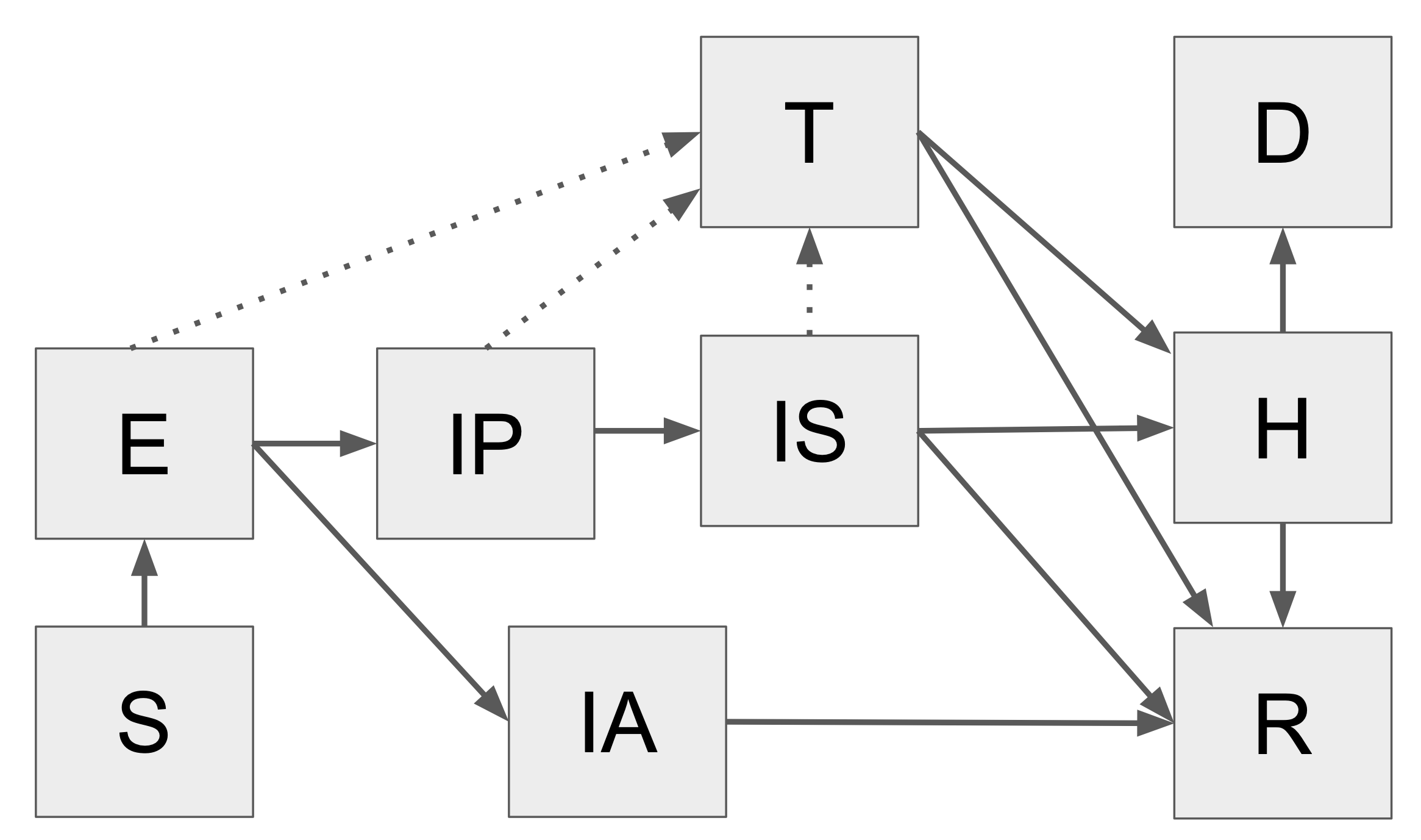
SEITHRD structure with exposed people eligible for antiviral allocation.
Parameter |
Description |
|---|---|
|
|
|
Target basic reproduction number. |
|
Mean exposed duration before the asymptomatic/pre-symptomatic split. |
|
Mean pre-symptomatic infectious duration. |
|
Mean time from symptomatic infection to hospitalization. |
|
Mean time from symptomatic infection to recovery without hospitalization. |
|
Mean asymptomatic infectious duration before recovery. |
|
Mean time from hospitalization to death. |
|
Age-specific mean time from hospitalization to recovery. |
|
Age-specific eventual proportion of exposed people who follow the asymptomatic path. |
|
Age-specific eventual hospitalization proportion among low-risk symptomatic people. |
|
Multiplier applied to low-risk hospitalization proportions for the high-risk group. |
|
Age-specific eventual proportion of hospitalized people who die. |
|
Infectiousness of |
|
Infectiousness of |
|
Optional age-specific susceptibility multipliers; defaults to all 1.0. |
|
SEITHRD mean treated duration before recovery for treated people who are not hospitalized. |
|
SEITHRD infectiousness of |
The configured split proportions are intended as eventual outcomes. When two destinations have different exit rates, the simulator adjusts the branch multipliers so the realized proportion still matches the requested value. See Mathematical Reference, under Competing Clocks.
SEAITRD Parameters
SEAITRD always uses S, E, A, I, T, R, D. Unlike the SEIRS, SEITRS,
SEIHRD, and SEITHRD families, T is not optional in SEAITRD inputs. Its
stochastic Gillespie implementation creates an individual event queue, while
its deterministic implementation uses daily Euler updates with the same
parameter meanings.
SEAITRD is a legacy model from when the original code base was in C++. We do not recommend using this model as it’s parameterization does not emulate the real-world well. However, it is a good example of a Gillespie model and may be of use to students, developers, or those interested in comparing model runtimes/limitations.
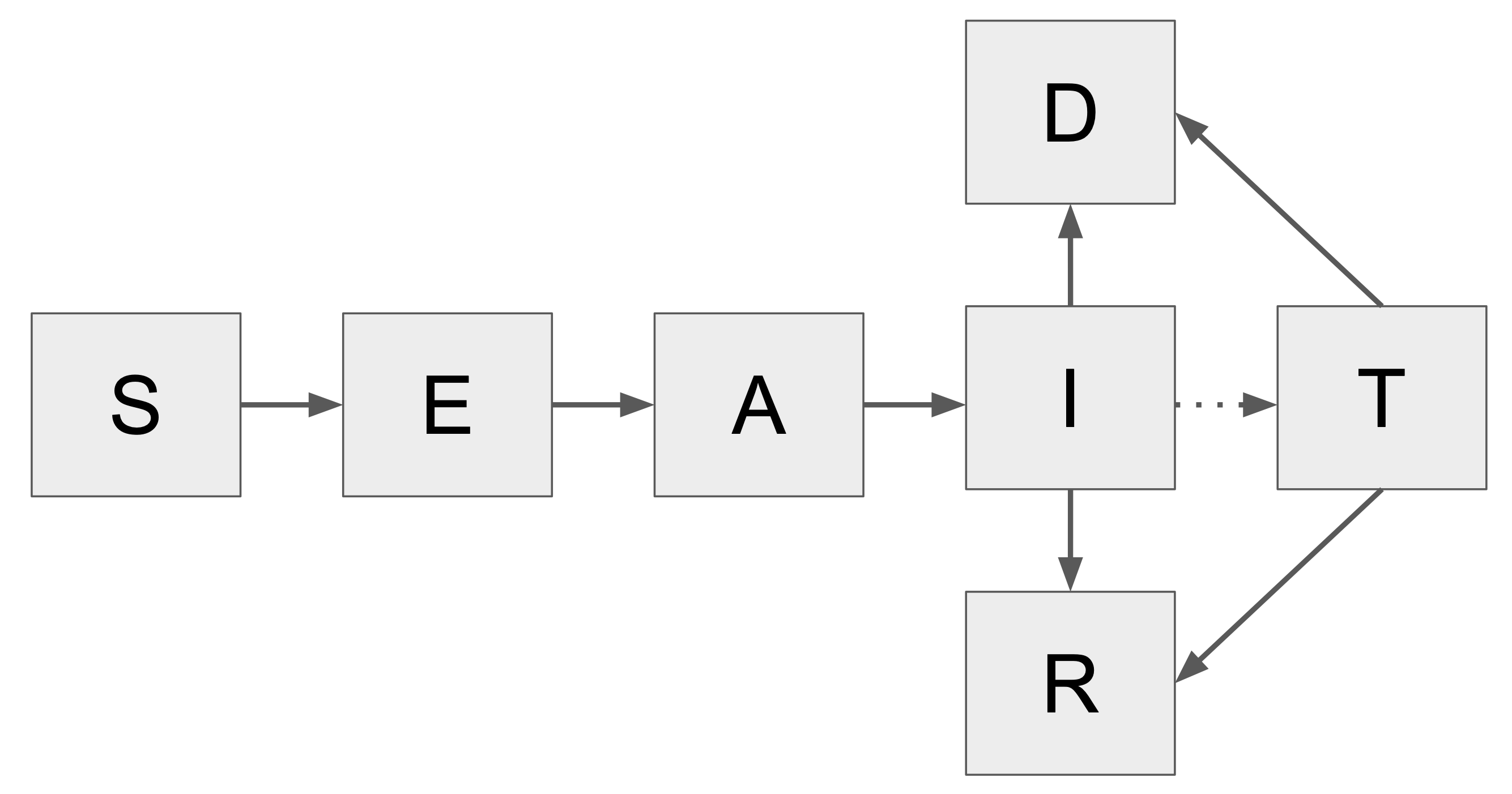
SEAITRD compartment structure.
Parameter |
Description |
|---|---|
|
Transmission target used with |
|
Calibration divisor; baseline beta is |
|
Mean duration from |
|
Mean duration from |
|
Mean untreated infectious duration before recovery. |
|
Mean treated infectious duration before recovery. Configure separately from |
|
Age-specific low-risk mortality rate per day for untreated |
|
Multiplier applied to |
|
Age-specific susceptibility multipliers. |
|
Optional relative infectiousness of treated people compared with untreated |
SEAITRD currently treats A, I, and T as equally infectious in its contact
process. In both deterministic and Gillespie stochastic SEAITRD, T is entered
only through released antiviral stockpile allocation. When an antiviral model
is configured for SEAITRD, provide antiviral_effectiveness_death; the treated
mortality rate is derived from I_to_D_invdays * (1 - antiviral_effectiveness_death).